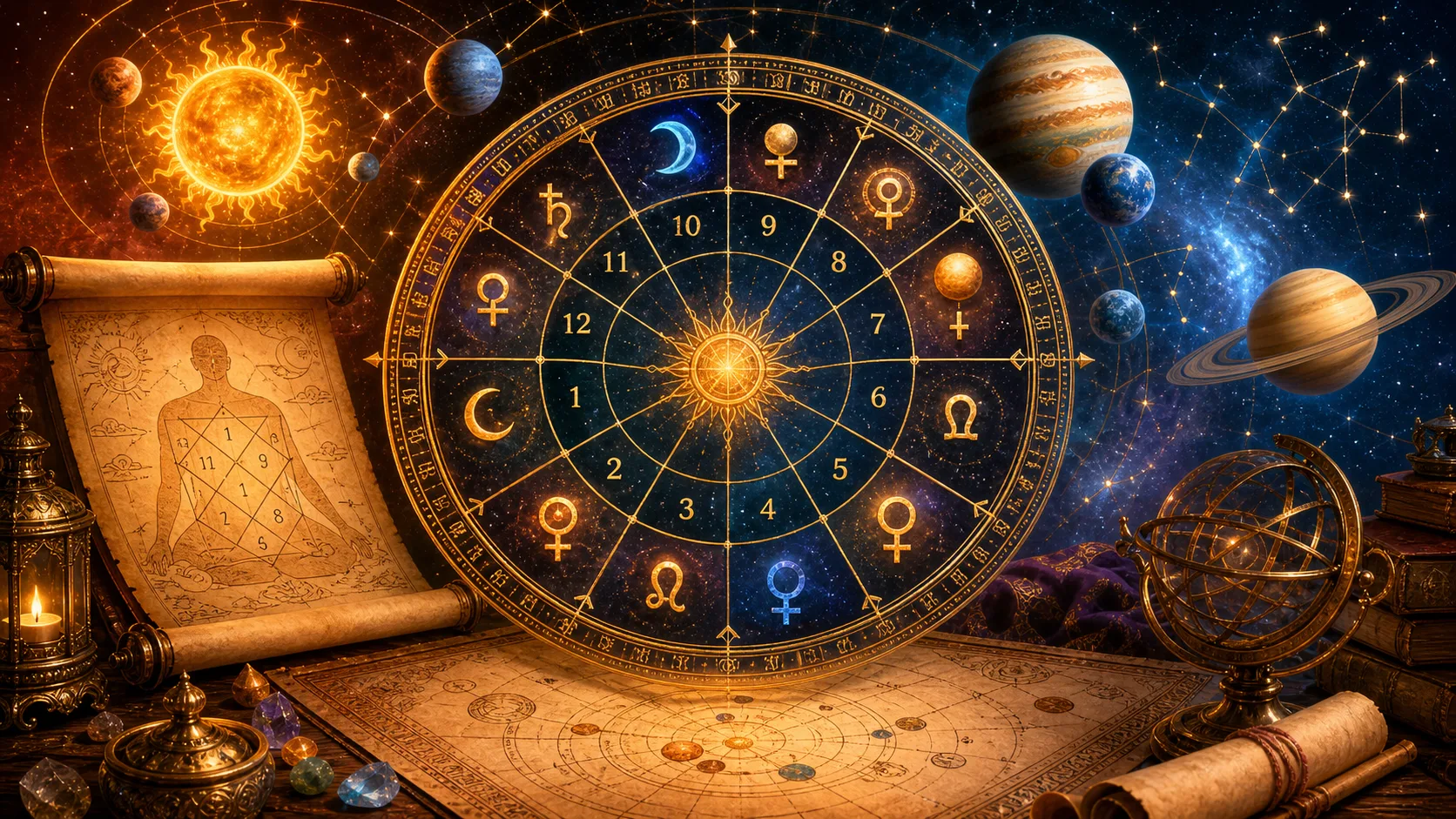
I Just Made My Janam Kundli — What Am I Actually Looking At?
Vedic Astrologer
Vedic Astrology Expert
A free birth chart can look like a wheel of symbols the moment it loads. Squares, numbers, planet names — and no one standing next to you to say where the eye should land. You do not need the whole of Jyotish on the first afternoon.
Start with three anchors: your Lagna (rising sign), your Moon sign, and the twelve houses. This is a calm first look at what each one shows, which birth details make the chart honest, and how to generate yours free on Aradhana’s Kundli tool at /kundli.
A janam kundli is a map of the sky at your birth, not a verdict
A janam kundli is a map of where the planets stood at your date, time, and place of birth. It is a picture of the sky, drawn as a chart. It is not a verdict on your worth, your income, or whether your life will “work.”
The loud versions — a hidden blueprint, a secret of wealth, a year already crowned as your best — ask the chart to do a job it does not do on a first read. The first job is literacy. Learn what you are looking at. Later questions can sit on top of that, and they still are not guarantees. If the screen feels loud, ignore the planet names for a minute. Find the three anchors below. The rest can wait.
Lagna, the rising sign — the “you” the chart is drawn around
Lagna is the sign rising on the eastern horizon at your birth. The whole chart is drawn around it. The first house is you: body, manner, the way you meet a room. Every other house is counted from this sign.
That is why two people born on the same date can have very different charts. The date fixes how the planets travel. The rising sign fixes the houses. If you remember only one thing from the first read, remember Lagna: it is the “you” the rest of the map is arranged around. You do not need to memorise the twelve signs today. Notice which sign your chart calls Lagna, and that the first house belongs to it.
Moon sign — the mind’s weather, not the whole of life
The Moon sign (Rashi) is the sign the Moon occupied at birth. It describes emotional weather: how you feel safety, how you react, the mind’s default. Everyday horoscope talk usually means this sign, not the Lagna.
The two get mixed. A sun sign, a Moon sign, and a rising sign are three different sentences. On a first read, keep them apart. Lagna is the chart’s frame. Moon is the mind’s climate. Neither one is your whole life, and neither one cancels the other. If the chart shows both, write them down. That pair is already a useful self-portrait, before any yoga is named.
The twelve houses in plain words — life areas, not predictions
The twelve houses are life areas. They are rooms, not fortunes.
In plain words: 1 self, 2 money and family speech, 3 courage and siblings, 4 home and mother, 5 children and creativity, 6 health and daily work, 7 partnership, 8 change and shared resources, 9 fortune and teachers, 10 career and public name, 11 gains and friends, 12 rest, letting go, and the inner life.
A planet in a house colours that room. It does not hand you a prediction on the first look. Saturn in the 10th is not “you will be famous,” and Venus in the 7th is not “you will marry this year.” On day one, only learn which room is which. The colour can come later, with someone who will not turn a room into a threat.
Date, time, and place — why a small time error moves the Lagna
The chart needs three facts: date of birth, time of birth, and place of birth. The date places the planets. The place sets the sky for that city. The time sets the Lagna.
Lagna changes about every two hours. A remembered time that is off by an hour can move the rising sign and, with it, every house. The Moon sign changes more slowly — about every two and a half days — so a small time error often leaves the Moon alone and moves the Lagna. If the time is exact, use it. If it is “around eight” or “early morning,” say so, and treat house lines as softer until the time is checked. Do not guess a minute just to make the wheel look certain. An honest chart with a soft time is better than a sharp chart built on a story.
Making your free chart on Aradhana’s Kundli tool
Open /kundli. Enter date, time, and place. Aradhana’s free Kundli tool draws the chart and shows the anchors this article uses: Lagna, Moon sign, and the houses those facts depend on.
On the first screen, do only this: note the Lagna, note the Moon sign, and glance at which house is which. Skip the urge to hunt a yoga, a dosha, or a year. You can come back. The tool is a map, not a verdict slip. If the time is unsure, generate the chart with the nearest known time and keep a note that the Lagna may shift. That note is part of an honest first read.
What to open next without overwhelm — and when to ask Guruji
Once the three anchors feel familiar, the next doors are optional and separate. Yogas are combinations, not a secret of wealth. Matching is a comparison of two charts, not a score that replaces knowing your own. Timing questions — marriage, work, a long Saturn season — each have their own calm read. You do not need all of them this week.
If the wheel still feels like noise, or the birth time will not settle, ask a person. The Aradhana app offers Guruji chat — the first conversation is free — so you can share date, time, and place and ask what these three anchors are actually saying. Bring the chart. Ask for the Lagna, the Moon, and one house you care about. Leave the rest for later. No first reading, including this one, has to explain a whole life. It only has to help you see what you are looking at.
Explore Free Janam Kundli
Discover your cosmic insights with our free Free Janam Kundli tool.
Use Free Janam Kundli ToolContinue in the Aradhana app
Aartis, daily horoscope, Guruji Seva and personalised muhurat — all in one free app, in your language.