What is Panch Mahapurusha Yoga?
Panch Mahapurusha Yoga — literally "five great person yogas" — is one of the most solidly classical yoga categories in Vedic astrology, explicitly named and defined in Brihat Parashara Hora Shastra under the chapter on the "Characteristic Features of Panchamahapurushas". Unlike more loosely-grouped modern labels, this is a genuine, textually well-attested classical construct.
The core rule
The rule is precise: one of five planets — Mars, Mercury, Jupiter, Venus or Saturn — must be in its own sign or its exaltation sign, and must additionally be placed in a Kendra house (1st, 4th, 7th or 10th) counted from the Lagna (ascendant). "Own sign or exalted" is a disjunctive condition — a planet occupies only one sign at any time, and its own sign and exaltation sign are always different, so requiring both at once would be impossible. When both conditions are met, one of five specifically-named yogas forms.
The five yogas
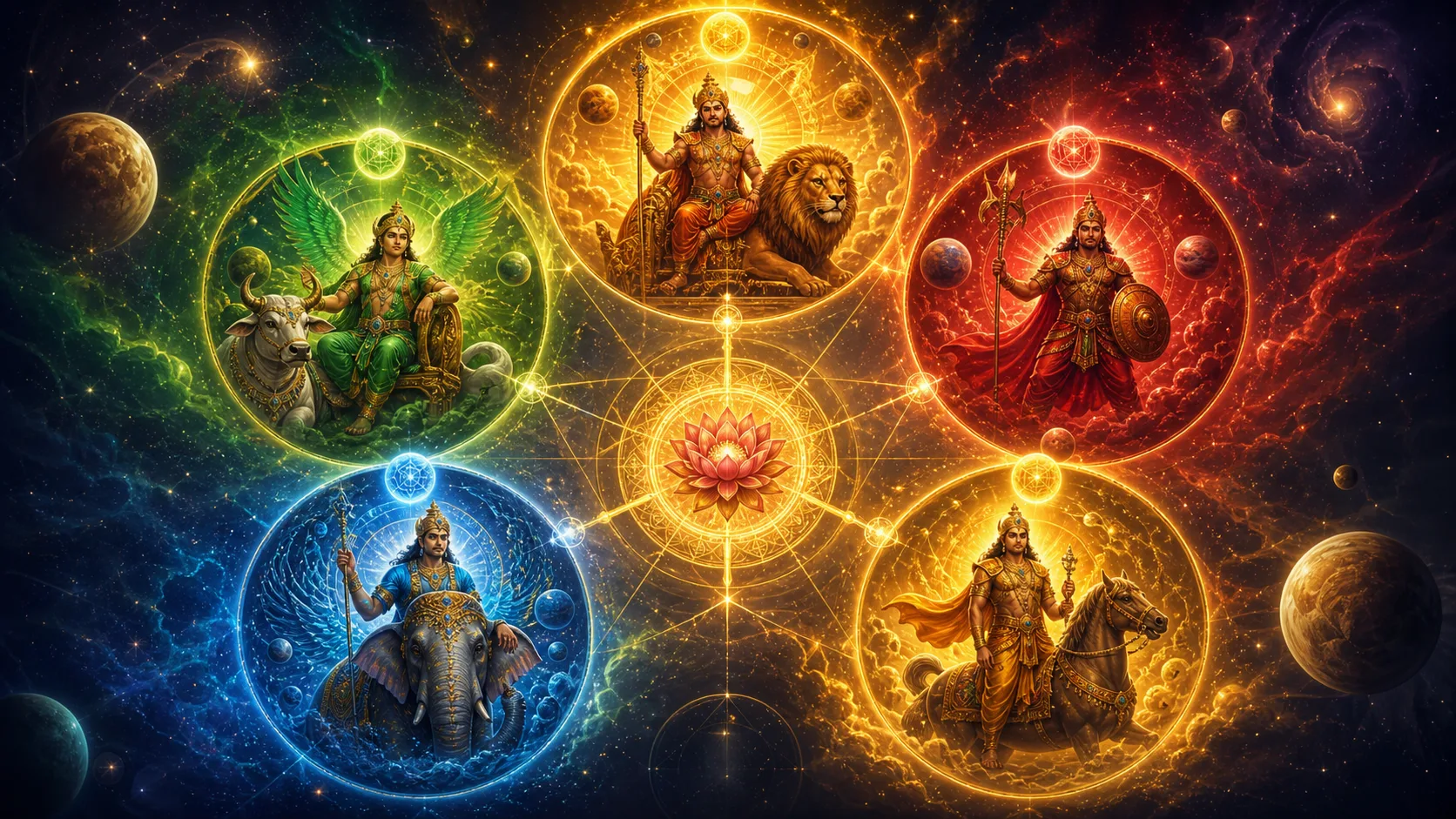
Ruchaka Yoga (Mars) is traditionally linked to courage, leadership, military or athletic prowess and fame won through bold action. Bhadra Yoga (Mercury) is linked to scholarship, eloquence and sharp business acumen. Hamsa Yoga (Jupiter) is linked to wisdom, righteousness, wealth, longevity and respected — often spiritually inclined — status. Malavya Yoga (Venus) is linked to personal charm, attractiveness, artistic talent and comfort. Sasa Yoga (Saturn) is linked to discipline, authority and leadership over the masses, often in political, administrative or service-oriented roles.
Counted from the Lagna only
The original classical verse counts the Kendra house from the Lagna (ascendant) alone. A supplementary check from the Moon (Chandra Lagna) circulates in some later traditions, but it is not part of the core Brihat Parashara Hora Shastra rule, so this calculator checks only from the Lagna.
Can more than one occur together?
Yes — since each of the five planets is checked independently, a chart can in principle carry two or more Mahapurusha Yogas at once. This is a rarer combination, though there isn't well-established classical evidence of a distinct name or specially amplified meaning for co-occurrence beyond each yoga's own individual significance.
What weakens or cancels the yoga?
This is a genuinely less-settled area. Broad claims that combustion, retrograde motion, or general malefic affliction weaken these yogas are not well-attested across classical sources, so this calculator does not apply such adjustments. A narrower, specific exception is cited in later Nadi-tradition texts for Malavya Yoga being weakened when Jupiter is conjunct or aspected by Saturn — but this is a distinct, narrower claim rather than a general cancellation rule. For a complete, personalised reading, consult Guruji on the Aradhana app.