What is Kaal Sarp Dosha?
Kaal Sarp Dosha, also known as Kala Sarpa Yoga, is one of the most widely discussed conditions in popular Indian astrology. It occurs when all seven classical planets — Sun, Moon, Mars, Mercury, Jupiter, Venus and Saturn — are positioned on one side of the axis formed by Rahu and Ketu, the lunar nodes, with none of them on the other side. The planets are said to be "hemmed in" between the two nodes, much like being caught between the head and tail of a cosmic serpent.
How the "hemming" is checked
Since Ketu always sits exactly opposite Rahu in the sky, the Rahu-Ketu axis divides the zodiac into two equal halves. Kaal Sarp Dosha exists when all seven planets fall entirely within one of those two halves — it doesn't matter which half, since both simply describe the same underlying pattern of the planets clustering to one side of the nodal axis.
Full vs partial (Ansh) Kaal Sarp Dosha
When all seven planets are hemmed with none breaking the pattern, it's called full Kaal Sarp Dosha. When six of the seven are hemmed but one planet sits just on the other side, it's commonly described as partial or Ansh Kaal Sarp Dosha — a milder version, though sources vary in exactly how they grade its intensity.
The 12 named sub-types
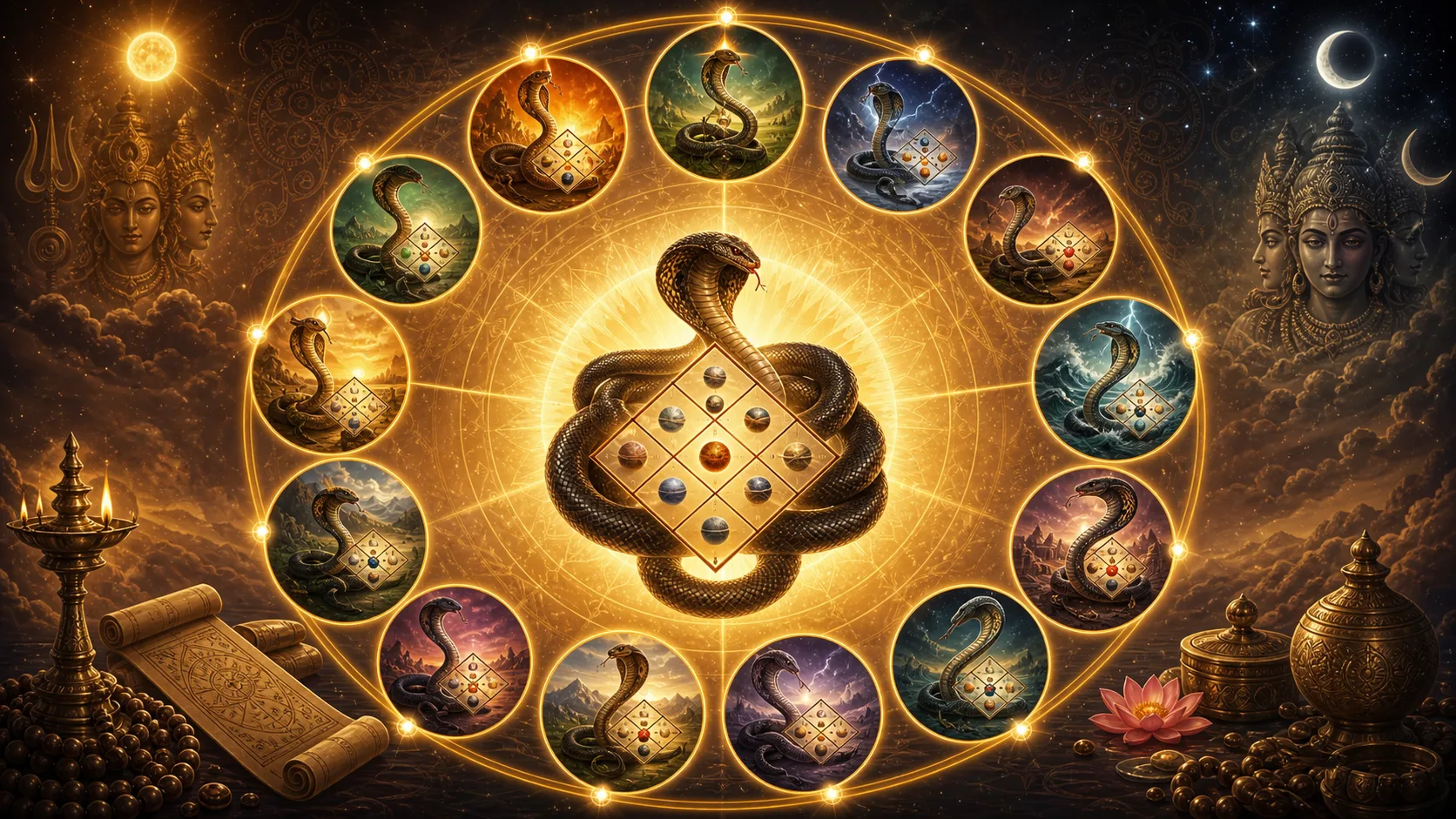
Kaal Sarp Dosha is further classified into 12 named types — Anant, Kulik, Vasuki, Shankhpal, Padma, Mahapadma, Takshak, Karkotak, Shankhachud, Ghatak, Vishdhar and Sheshnag — based on which house Rahu occupies counted from your Lagna (ascendant), running from the 1st house through the 12th. This naming system is extremely widely repeated across popular astrology sources.
Is this an ancient or modern concept?
Importantly, Kaal Sarp Dosha under this specific name and framework is not clearly described in the oldest classical texts such as Brihat Parashara Hora Shastra. It is widely understood among astrology researchers to be a largely modern, 20th-century popularisation rather than an ancient doctrine — though the broader idea of planets positioned relative to the lunar nodes has older roots in Vedic astrology. This tool presents it as a well-known popular tradition, not settled ancient scripture.
Common remedies
Traditional remedies widely associated with Kaal Sarp Dosha include performing a Rahu-Ketu Shanti puja (commonly at the Trimbakeshwar Jyotirlinga temple in Nashik), observing Nag Panchami, chanting the Maha Mrityunjaya and Rahu/Ketu mantras, and charitable acts like feeding the needy. For a complete, personalised reading, consult Guruji on the Aradhana app.